
Senior Relocation Services: Gentle Transition Support for Assisted Living (2026)


The relocation environment of 2026 operates at the intersection of complex regulatory frameworks, shifting demographic patterns, and rigid logistical constraints. For families in the South Bay, the objective is not merely to transport household goods. The goal is to execute a "Gentle Transition" that mitigates the physiological and psychological stress known as Transfer Trauma.
This is not a "California Exodus." Data from 2025 indicates a "Silver Shuffle"—a robust pattern of intrastate migration where seniors rightsize from asset-heavy properties in Almaden Valley or Silver Creek to service-rich communities within the same region. "My Dad's Moving Inc.," based in Morgan Hill, manages these high-stakes relocations by prioritizing local logistical intelligence over generic speed.
Moving a parent is not a DIY project; it is a precision operation requiring compliance, empathy, and specific knowledge of the 2026 infrastructure landscape.
Federal and State Moving Regulations: The 2026 Compliance Shield
For a senior move, compliance serves as the primary indicator of safety and legitimacy. The vulnerability of the senior demographic makes them prime targets for "rogue movers." A professional carrier distinguishes itself through rigid adherence to the 2026 regulatory environment.
The FMCSA "One Master" Rule and Asset-Based Carriers
The Federal Motor Carrier Safety Administration (FMCSA) governs all interstate commerce. In 2025, the regulatory environment tightened significantly to protect consumers from "Hostage Load" scenarios—situations where a fraudulent broker quotes a low price, then subcontracts to a carrier who demands thousands more to release the goods.
The "One Master" Rule, enforced as of 2025, prevents a broker from accepting compensation for a load they also dispatch as a carrier. This eliminates the conflict of interest inherent in "double brokering" schemes. For a family moving a parent from Morgan Hill to Oregon, knowing the mover is the actual carrier (Asset-Based) rather than a broker is the single most important safety factor. My Dad's Moving Inc. maintains a physical fleet and employs drivers directly. We do not farm out your contract to unknown third parties.
CPUC MAX 4 Tariff and Price Certainty
For intrastate moves (e.g., Gilroy to Cupertino), the California Public Utilities Commission (CPUC) serves as the governing body. The MAX 4 Tariff sets the rules of engagement.
The CPUC requires a "Not To Exceed" price on the Agreement for Moving Services. This provides a financial cap; the mover will not charge more than this cap unless a specific "Change of Service" is signed for additional items added on the day of the move. This rule protects seniors on fixed incomes from open-ended billing.
Additionally, "Double Drive Time" (DDT) is a consumer protection law often misunderstood. Instead of paying for the crew to drive back to the yard in unpredictable traffic, the customer pays exactly double the time between origin and destination. If the drive from Morgan Hill to The Terraces takes 45 minutes, the drive time charge is 90 minutes. This provides cost certainty, shielding the customer from paying for a 3-hour traffic jam on Highway 101 during the crew's return trip.
Full Value Protection (FVP) vs. Released Value
There is a misconception that movers automatically "insure" goods. They provide Valuation.
Released Value (Basic): This federally mandated minimum covers goods at $0.60 per pound per article. If a 50-pound flat-screen TV drops, the payout is $30. If a 5-pound Ming Vase shatters, the payout is $3.00. This coverage is inadequate for senior households filled with accumulated assets.
Full Value Protection (FVP): This is the standard for senior relocation. Under FVP, if an item sustains damage, the mover must repair it to pre-move condition or replace it with a like item at current market value. We strongly recommend FVP for any move involving antiques, art, or high-value electronics. It transforms the contract from weight-based liability to value-based protection.
Navigating South Bay Infrastructure: The 2026 Blind Spots
A national van line driver lacks the "tribal knowledge" of the South Bay's infrastructure quirks. In 2026, these quirks are amplified by major construction projects and rigorous municipal enforcement. Generic GPS systems often fail to account for temporary weight restrictions or recent code changes.
The Hale Avenue Sewer Project Impact
The Upper Llagas Creek Flood Protection Project continues to impact Morgan Hill in 2026. specifically, the construction of a new sewer siphon has triggered major road closures. Hale Avenue is scheduled for closure from Longview Drive to Llagas Road between May 2026 and December 2026.
Hale Avenue is a primary north-south artery for the western foothills of Morgan Hill—prime residential territory. A moving truck attempting to navigate the narrow detours of residential side streets risks getting stuck or facing weight-restriction fines. Routes must be planned via DeWitt Avenue or Santa Teresa Boulevard. This adds approximately 15-20 minutes to the transit time, which must be factored into the estimate to remain accurate.
San Jose Virtual Permitting and RPP Zones
Parking a 26-foot or 53-foot moving rig is not a simple task. Each municipality has distinct codes.
Morgan Hill & Gilroy: The Municipal Code prohibits parking commercial vehicles or unattached trailers on residential streets unless actively loading. Residents often cite a "72-hour parking rule," but this applies to passenger cars. Leaving a moving trailer unhitched overnight on a street like Dunne Avenue is a code violation that results in towing.
San Jose (Willow Glen, The Alameda): As of 2022, San Jose reactivated strict enforcement of Residential Permit Parking (RPP) zones. For a move in a dense area, relying on finding 60 feet of open curb is a gamble. The solution is the Tow-Away Permit. It costs approximately $50 plus $8/day per meter space and allows the placement of signs 72 hours in advance.
Crucially, San Jose now uses License Plate Recognition (LPR). There are no physical hangtags. The moving truck's license plate must be entered into the virtual permit system. Failure to do so results in an automated citation from passing enforcement vehicles.
Microclimates and the "Rainy Season" Protocol
The Bay Area's climate is characterized by microclimates. A move starts in sunny Morgan Hill and ends in a downpour in Los Gatos. The rainy season (November–March) brings "Pineapple Express" storms.
The Tarp Canopy: A professional crew does not run fast in the rain. They construct a "dry tunnel." Using tension poles and heavy-duty tarps, we create a canopy from the back of the truck to the front door. This prevents water from entering the truck bed.
Floor Protection: We use Neoprene Runners rather than plastic film. Plastic becomes slippery when wet, creating a fall hazard. Neoprene grips the floor and absorbs moisture. For hardwood floors, we lay rigid Masonite sheets to protect against the pressure of mud-caked boots and heavy dollies.
Senior Relocation Services. Facility-Specific Protocols: Destination Intelligence
A move finishes only when the senior is settled. Each major South Bay community has a unique logistical ecosystem. Our senior relocation services team operate in these facilities weekly and understand their unwritten rules.
Merrill Gardens (Gilroy, Morgan Hill, Campbell)
Merrill Gardens emphasizes a community-integrated welcome process. We coordinate directly with the designated family "Support Team" and the Move-In Coordinator.
Logistics: Move-in hours are typically restricted to avoid meal windows (11:30 AM – 1:30 PM). Elevators are high-traffic zones during lunch service.
The "First Night" Box: Merrill advises packing a separate, easily accessible box containing medications, toiletries, pyjamas, and bedding. We label this with high-visibility tape and place it in the truck cab, not the cargo bay. It enters the room first.
Sunnyview Retirement Center (Cupertino)
Sunnyview is a Continuing Care Retirement Community (CCRC) with a massive 12-acre campus.
The "Long Carry" Challenge: Many independent living villas are set back from the main road along winding paths. A 53-foot tractor-trailer often cannot access these units. We deploy a "shuttle" vehicle (a smaller 16-foot truck) to ferry goods from the main rig to the villa door. Identifying this need during the estimate prevents day-of delays.
Wellness Integration: New residents often want to engage immediately with the wellness facilities. We prioritize unpacking their "active wear" and walking shoes so they will join the community flow on Day 1.
The Terraces of Los Gatos
A premier Life Plan Community, The Terraces requires a "White Glove" approach.
Elevator Reservations: The facility has specific service elevators that must be booked weeks in advance. Missing this window will result in the truck being turned away. We manage this reservation as part of our service.
Parking Restrictions: Located on Blossom Hill Road, parking is tight. We coordinate with security to access the loading dock, ensuring we do not block emergency vehicle access to the adjacent healthcare center.
Rightsizing Support: Residents here often move from large Los Gatos estates. We often perform a two-stage move: essential furniture first, followed by art and decor once the resident has lived in the space for a few days.
The Physics of Packing: High-Value Asset Preservation
Packing utilizes engineering principles to protect assets. For senior households containing items of sentimental and financial value, standard packing is insufficient.
The Dish Pack and Cellular Engineering
The "Dish Pack" is a double-walled, extra-strength carton. We utilize a Weight-Layering technique based on vector force distribution.
The Crush Bed: The bottom 3-4 inches are filled with crumpled unprinted newsprint. This acts as the primary shock absorber, decoupling contents from truck floor vibrations.
Vertical Anchor: Plates must never lie flat. A flat plate has poor beam strength and will crack under weight. A vertical plate transfers force through its rim, its strongest point. We create a "spine" of vertical plates.
The Shake Test: The final step involves filling every void with crushed paper. A correctly packed dish pack must have zero internal movement. If it rattles, we repack it.
Piano Logistics and High Centers of Gravity
Pianos pose unique risks due to their weight (400-800 lbs) and high center of gravity.
Upright Pianos: We utilize a Piano Skid Board and a Hump Strap. The piano is strapped to the skid board, acting as a sled. The "Hump Strap" allows the mover to lift using their back and shoulders, providing finer control than forearm lifting.
Grand Pianos: The "Lyre" (pedal assembly) is removed first. The piano is tipped onto its long straight side (the bass side) onto the padded skid board. Legs are removed and numbered. For long-distance moves (e.g., CA to AZ), we monitor humidity as drastic changes will crack the soundboard.
Emotional Logistics: Managing Transfer Trauma
In 2026, the best movers function partly as therapists. The National Association of Senior Move Managers (NASMM) sets the standard for the emotional side of relocation.
Transfer Trauma: Also known as Relocation Stress Syndrome, this reaction involves confusion, anxiety, and sleeplessness. The antidote is control and familiarity.
The Shadow Move: We often recommend the family takes the resident out for a long lunch while we work. The resident should ideally arrive after the room is set up. We take photos of the resident's previous bedroom layout—nightstand placement, photo frames, clock—and replicate it exactly in the new room. Familiarity mitigates anxiety.
Legacy Conversations: Rightsizing often feels like losing history. We reframe this by facilitating the shipment of heirlooms to family members. "We are not discarding the piano; we are shipping it to your granddaughter in Austin." This turns a loss into a legacy gift.
Frequently Asked Questions
How much does it cost to move to assisted living in San Jose?
For 2026, local moves are hourly. Rates generally range from $180 to $280 per hour depending on crew size (2-4 men). An average senior apartment move typically costs between $1,500 and $3,000. Interstate moves are priced by weight and distance, with fuel surcharges currently averaging 15% due to diesel volatility.
Does Medicare pay for senior moving costs?
Generally, no. However, some Long-Term Care Insurance policies have provisions for "relocation benefits" if the move is medically necessary. We advise families to check their policies. Additionally, "Bridge Loans" are available to cover the gap between moving into the community and the sale of the home.
What is the difference between a senior move manager and a mover?
Senior Move Managers (SMMs) specialize in the emotional and organizational aspects of downsizing, such as sorting possessions and floor planning. Movers handle the physical labor, transport, and logistics. My Dad's Moving Inc. frequently partners with SMMs to provide a seamless experience.
What is the checklist for moving a parent with dementia?
Safety and familiarity are paramount.
Safety Audit: Remove cleaning fluids, razors, and trip hazards before the move.
The First Night Box: Pack essential items separately.
The Shadow Move: Arrange for the resident to arrive only after the room is fully set up.
Replication: Place familiar items (photos, clocks) in identical positions to the previous home.
Conclusion: Securing a Gentle Transition
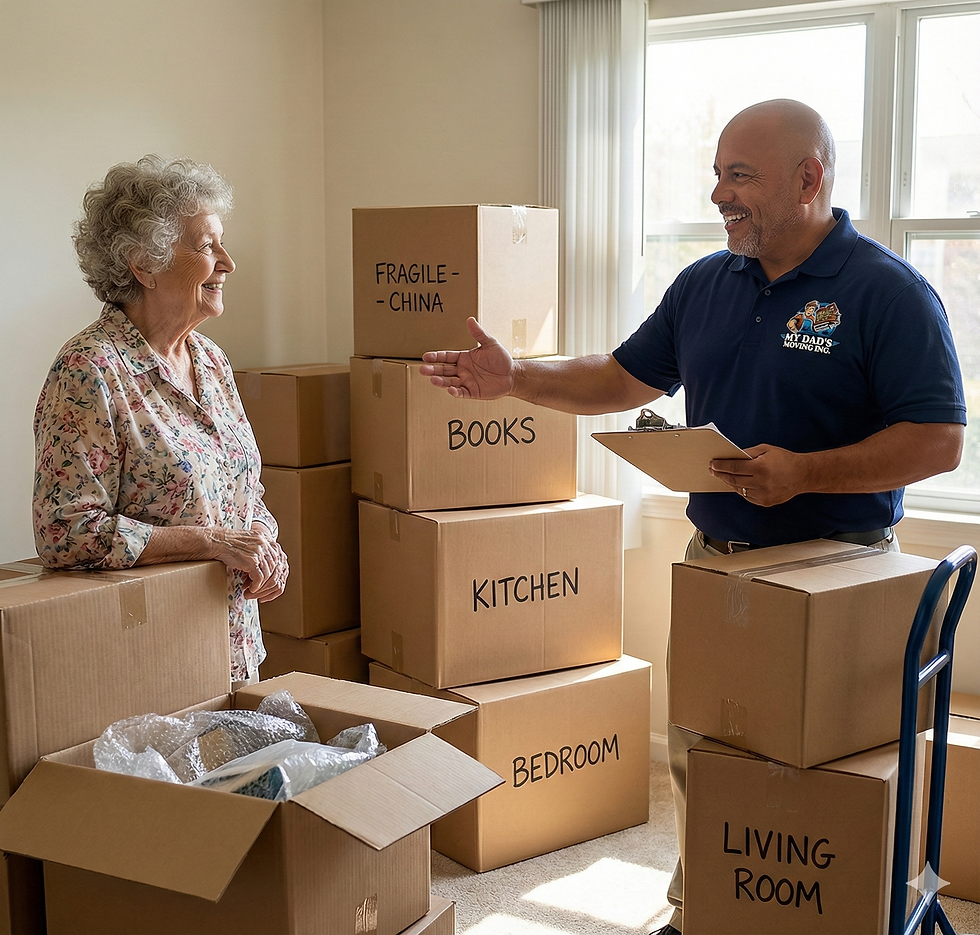
In the complex landscape of 2026, moving a parent demands the precision of a military deployment and the empathy of a caregiver. My Dad's Moving Inc. offers a distinct advantage: Local Intelligence. We know the Hale Avenue closure adds 20 minutes to the drive. We know the Sunnyview villas require a shuttle. We know the "One Master" rule protects your interstate shipment.
By choosing a mover who understands the regulatory shield of the CPUC, the physics of the dish pack, and the psychology of the "Shadow Move," you secure a gentle transition for the people you love most.


Comments